
The Good Life according to the ancient philosophers

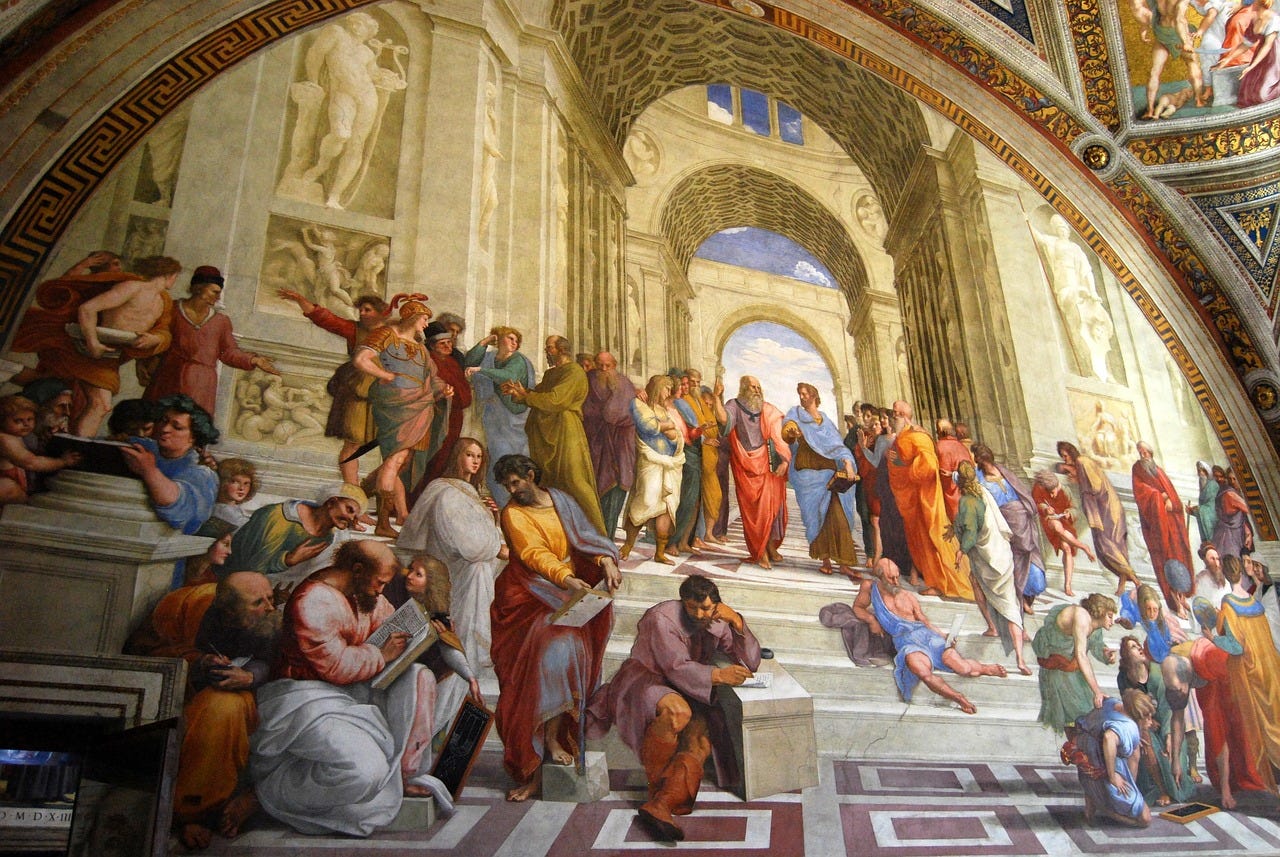
Turn back time by over two thousand years and travel to the lands of Greece and you will find various competing schools vying for your custom. The teachers would promote themselves as experts, but more precisely they would suggest that what they taught was better than what any of the other schools taught. They would each claim that they held the knowledge on how a human-being could live a good life and what the meaning of life must be. More than that, they promised to teach their students the tools which they would need to live that life as well.
Modern philosophy, of course, is far removed from these Greek philosophical schools. Philosophers these days tend to be engaged in the theory of how existence works. Few, if any would see it as their job to offer practical solutions for people to lead a good life. This is more the role of psychiatry.
That was certainly not the case in the era of Plato, Pythagoras, and Aristotle. Ancient Greek philosophical schools were numerous and offered different flavours of teachings ranging from cynicism, scepticism, stoicism, and epicureanism, amongst much else. Each philosophised different tools and approaches for achieving a good life and each differed somewhat on what a good life meant. However, what generally mattered most was the quality and fame of the chief teacher.
Celebrity culture in Ancient Greece was all about lectures. That was where the cool kids hung out!
I may have given the impression thus far, that the philosophical schools were all focused on teaching the good life. This is not quite right. Whilst different schools had specific focuses, most included some element of astronomy, epistemology, mathematics, politics, ethics, metaphysics, logic, biology, and ontology. The most successful tended to also include teachings in rhetoric, partly as a means to encourage the wealthy and ambitious to send their children to their schools. Rhetoric was a life-skill of the upmost importance in ancient Greece (the equivalent today, would be the ability to write well). In the words of Aristotle, rhetoric is ‘the faculty of observing in any given case the available means of persuasion’.
These schools, then, were not just trying to teach their pupils about how to achieve a good and worthwhile life, but also how to progress into the upper echelons of society. The ability to persuade played a critical role in ones ability to be successful in ancient Greece. In short, what they taught was a philosophy of life, which would help their pupils to be successful and happy and positively engaged in public life.
Pathways towards happiness and a life lived well, were, nonetheless, prominent concerns of ancient philosophers. We only have glimpses of this. What survives in terms of their writings and accounts, is small, compared to the likely output of their in-person lectures, and even of their original writings. We rely on scraps, accounts through third-party scribes (such as students), and the occasional full-length treatise. It’s enough though, to get a sense of what the ancient philosophers thought was a meaningful approach to the question of living well.
So, what did they suggest for a good life? This is a complex question, as the different schools and teachers taught different paths and suggested tools of their own devising. A few key tenants can be highlighted, however, that reflect most, if not all, the teachings of ancient Greece and its successor, the Roman Empire.
1. The meaning of life
Most schools argued that there is an ultimate aim in life (a meaning, if you will), which all other wants, desires, and needs, are ultimately in service towards. Aristotle and others believed that this ultimate aim was a sense of tranquillity, which they called Eudaimonia. If Eudaimonia could be achieved then that person would be better able to function and contribute to society, would be better equipped to relate to the gods, and find earthly peace, happiness, and wellbeing. The Epicureans thought that the ultimate aim in life was seeking pleasure (which is not quite as hedonistic as it might sound), whilst the Skeptics believed that a perpetual state of inquiry was necessary. Skeptics believed that judgement was a block to happiness, and that only by continually questioning everything, could one find fulfilment.
2. A basis in ethics and knowledge
The ancient schools not only taught a way of living a life, but also the key skills necessary to contribute well to society. They therefore, taught numerous subjects ranging from ethics, mathematics, astronomy, and rhetoric to help their students to be knowledgeable and learned. A basis in ethics and learning was therefore key to any identification of a good life.
3. Engagement with public life
Whilst many of the schools taught techniques for inner-perfection, the focus was also on engagement with society. Contribution to public life was important in ancient Greece and Rome. It was seen as a duty that each individual citizen should perform a civic role in some capacity. Therefore, the path to a good life was not just one of inner tranquillity or happiness, but also one that had a positive impact. It was a life which engaged with society, politics, and religion, and one which sought to leave a better world behind them.
Summary
The ancient philosophers, therefore, differed on what a good life might be like and how to achieve it, but they agreed that it should:
Focus on perfecting the individual
Ensure that those individuals engaged positively and actively in the world
Use knowledge and understanding, rather than ignorance, as their guide.
These were key elements suggested for a good life, but there is much more in the detail. We shall come to what the different teachers suggested in future essays. There is, however, one more thing that many of the ancient schools taught their students; that is a sense of simplicity. Today over-consumption and a desire for more and more things is omnipresent. There is no sign that human nature was all that different in the ancient past, only more restricted in what each individual could consume and experience. Yet, the schools tried to instill a sense of living within ones means, and living a simple, uncomplicated life. This was an issue then, as it is today. In the next essay we shall turn to the meaning of a simple life, as this comes to the heart of what it may mean to live a good life, especially in a world on the brink of ecological collapse.
This article is free for all readers. If you would like to support our work with a one-off contribution, click the “Buy me a Coffee” button below.
If you would like to support Side Stepping Normal with a monthly or annual subscription, and receive more of our writing about finding a good life in a time of climate change and ecological decline, click the “Subscribe now” button below for options.